
In-Game Ads optimization
5 min read


By
Mati Bochenczak
Justin Stolzenberg
Director of Business Development
Co-founder
Apr 30, 2026
Most monetisation teams are focused on getting the price right. They treat it like it’s the whole job. But the uncomfortable reality is that you can feel like you’re setting the perfect floor and still make nothing if your auctions don’t fill.
Most teams are not truly optimising all variables within an auction, even if they think they are. The result is a growing amount of lost revenue.
Bidding-based ad monetisation used to feel straightforward, with three clear steps, cleanly sequenced:
Identify your best players. Set a sensible floor. Let the auction do the rest.
That world does not exist anymore.
Every impression sits inside a constantly shifting marketplace. Demand rises and falls, budgets move, and networks respond differently depending on how calls are made, how fast they arrive, and how reliable they are.
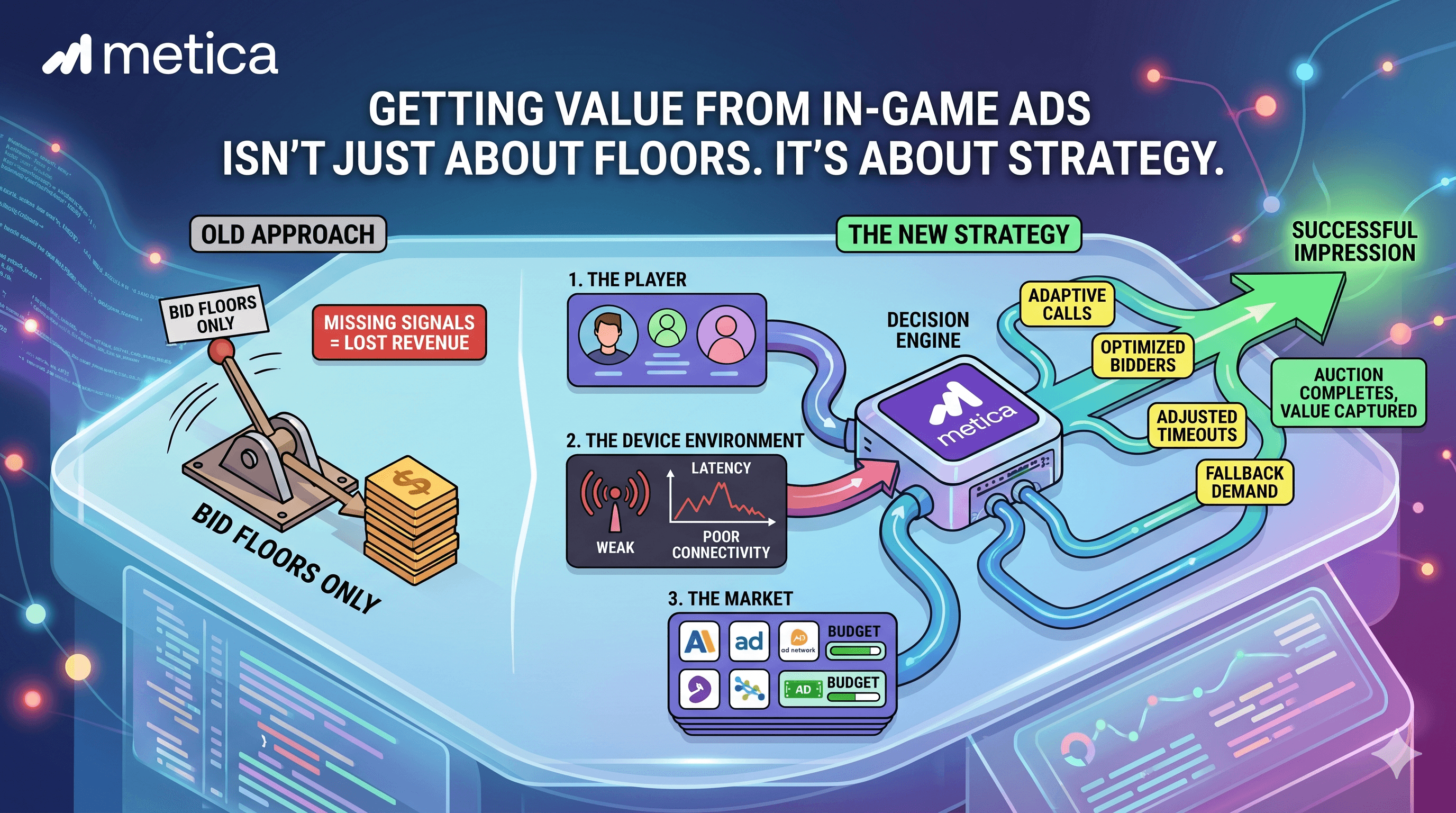
To get the best price, a system needs to understand three things simultaneously:
The player. The device environment. The market.
Miss any one of those, and value is left on the table.
When pricing became a strategy
When the industry moved on from waterfall models to real-time bidding, the logic was simple: more competitive auctions would naturally produce better prices.
In theory, that made sense. In practice, it didn't always work that way, not because ad networks were doing anything wrong, but because they were often missing meaningful signals about individual players. Without enough context, bids settled lower than the true value of the inventory.
Publishers noticed quickly. So the industry evolved. Games started setting bid floors, i.e. minimum acceptable prices that gave the market clearer signals. Demand responded, competition strengthened, and prices improved.
Bid floors were not just a pricing tool. They became a way to guide the auction.
The next realisation: bidder sets, timeouts, and call structure shape revenue as much as floors do
As monetisation systems matured, it became clear that ad networks were reacting to more than just the number attached to an impression.
They were responding to how auctions were structured and executed. How large the bidder set was. Whether calls were made in parallel or sequence. Whether timeout windows were long enough to capture demand without killing fill rate. How reliably an auction completed.
All of these signals influenced outcomes. This is where auction execution started to matter as much as the floor itself. Setting the right floor is important. But finding the highest price while still securing a bid is a moving target, changing from user to user, session to session, moment to moment.
That balance depends not only on price, but on how the auction is executed. In other words, the right price means nothing if the auction cannot deliver it.
What this looks like in the real world
Consider a high-value player during an active session. Everything about their behaviour suggests strong monetisation potential, and historical data indicates a high expected value. A pricing-only system pushes aggressively, setting a high floor to maximise revenue.
Now imagine that same player is on a bus with poor connectivity. Latency spikes, requests slow and responses fail.
A system working purely from prediction keeps pushing high floors, expecting strong competition. The result is a lost impression and the auction cannot complete in time.
A strategy-aware system behaves differently. It detects the shift in device environment and adapts the auction to maximise the chance of a successful fill. That might mean reducing timeout windows, limiting the bidder set to those most likely to respond quickly, prioritising faster networks, or using fallback demand if responses are delayed. The goal is not simply to adjust the price, it is to ensure the auction actually completes and captures value.
The result is a filled impression instead of a lost one. Across millions of sessions, those recoveries compound into meaningful revenue. Auction completion is as important as pricing accuracy.
How the industry approaches this today
Most modern optimisation tools focus on improving pricing and tend to optimise one part of the problem, not the whole system.The solutions available tend to fall into two categories.
Mediation platforms and control-heavy tools rely on teams to define segments, configure rules, and run experiments. That works at a high level, but breaks down as conditions change faster than teams can react.
Pricing-first tools improve the accuracy of the floor, but still depend on the underlying mediation setup to execute the auction. If that execution is suboptimal, a better price does not translate into better revenue.
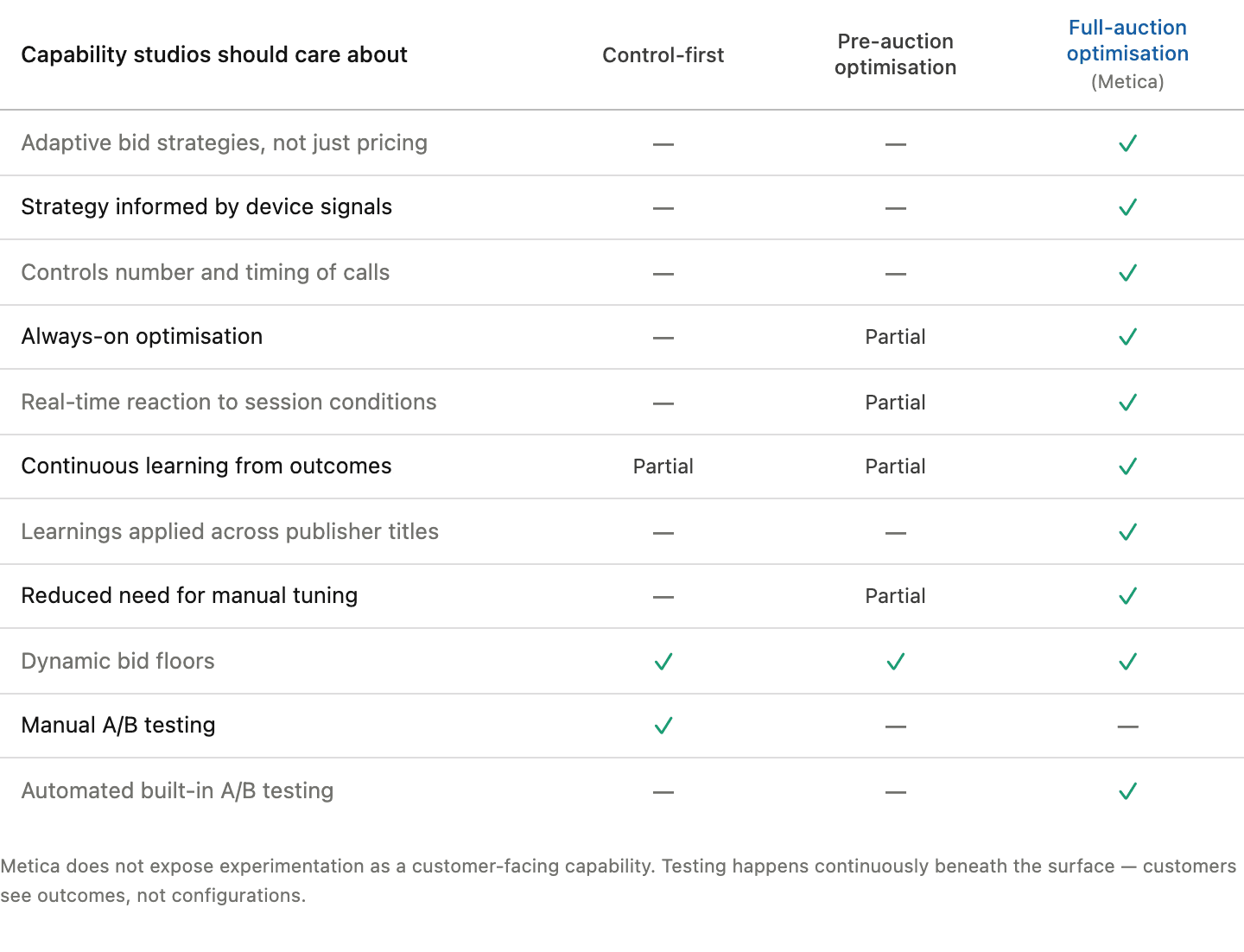
In both cases, decision and execution are split. The system suggests what should happen, but does not control whether it actually happens in the moment the auction runs.
Manual control sounds appealing with dashboards, segmentation rules, A/B tests, the ability to refine outcomes over time. That worked when optimisation happened at a broad segment level and changes were relatively slow.
But once you move toward true player-level optimisation, manual control stops being practical. The number of possible combinations grows too quickly. Different players, different session conditions, different market states. Even modest games quickly produce thousands of permutations. Larger ones produce millions. We’ve written on this concept a lot in our previous articles on the Metica Blog such as Ditch Segmentation.
The underlying principle holds: at sufficient complexity, automation is not a feature. It is a requirement. The role of the team shifts from manually adjusting strategies to guiding the system and defining the outcomes it should optimise for.
The shift from floors to strategies
At some point, the leading games stopped asking only 'what price to set?', and started asking a harder question.
'How should the auction actually run?'
Which is a combination of: how many networks to call; in what order; at what speed; under what conditions; whether to prioritise completion or price when the two are in tension. These are not separate from pricing decisions. They are what complete them. And they determine whether revenue is realised or lost.
And that’s why these games are leading.
A different architecture, Metica’s architecture
This is what we aim to help all games with. Rather than generating prices or giving teams tools to experiment manually, Metica removes the gap between decision and implementation entirely. The system owns both.
Bid floors are not exposed as values to manage. Experiments are not configured manually. Instead, Metica continuously runs large-scale testing beneath the surface and adjusts both pricing and calling strategies automatically. Studios see outcomes, not configurations.
Critically, all time-sensitive decisions are made on the device, not on a server after a round trip. That matters because the most valuable signals do not exist in historical data. They exist in the moment the ad call happens.
Connectivity quality. Latency. Session behaviour. Real-time device state (network type and available memory).
When those signals change, the strategy changes with them. Not after analysis, but immediately. The result is more complete pricing with decisions that account for whether value can actually be captured in the moment, not just what that value should theoretically be.. Over time, that difference compounds.
There is a broader reason this architecture makes sense beyond pure performance. Game studios are exceptional at building engaging experiences for players. Monetisation optimisation at the level of continuous experimentation and model tuning is a different discipline. It requires specialised expertise, dedicated bandwidth, and the kind of scale that many teams find challenging alongside their core work. Metica is designed to collaborate with teams of all scales, where for smaller teams we can absorb that burden entirely, so studios can stay focused on making great games rather than managing bid floor strategies. For larger teams, we work with existing optimisation teams to find bespoke strategies that are particularly fine tuned for their games.
The system also learns across titles within the same publisher. Insights from one game can improve decisions in another, compounding the value of the data a publisher already holds, while keeping everything fully within their ecosystem. The longer a publisher works with Metica, the more accurate its decisions become.
Why better strategy benefits the wider ecosystem
Better strategy does not just benefit publishers. It supports the health of the auction ecosystem as a whole.
Ad networks perform best when pricing signals are justified, consistent, and grounded in real behaviour. Poorly calibrated floors, like those set too high, suppress competition and reduce fill rates. Floors set too low leave publisher revenue unrealised. When inventory is priced accurately and executed reliably, auctions become more predictable for both sides.
Both publishers and demand partners benefit when auctions run well. Good strategy strengthens both sides of that equation.
Don't be left behind
The shift has been gradual but there is a clear separation happening between teams whose systems consistently capture that value, and those that leave it behind without ever realising it. Metica exists to close that gap.
Most of the revenue you're leaving behind isn't obvious. That's the problem.
Talk to us